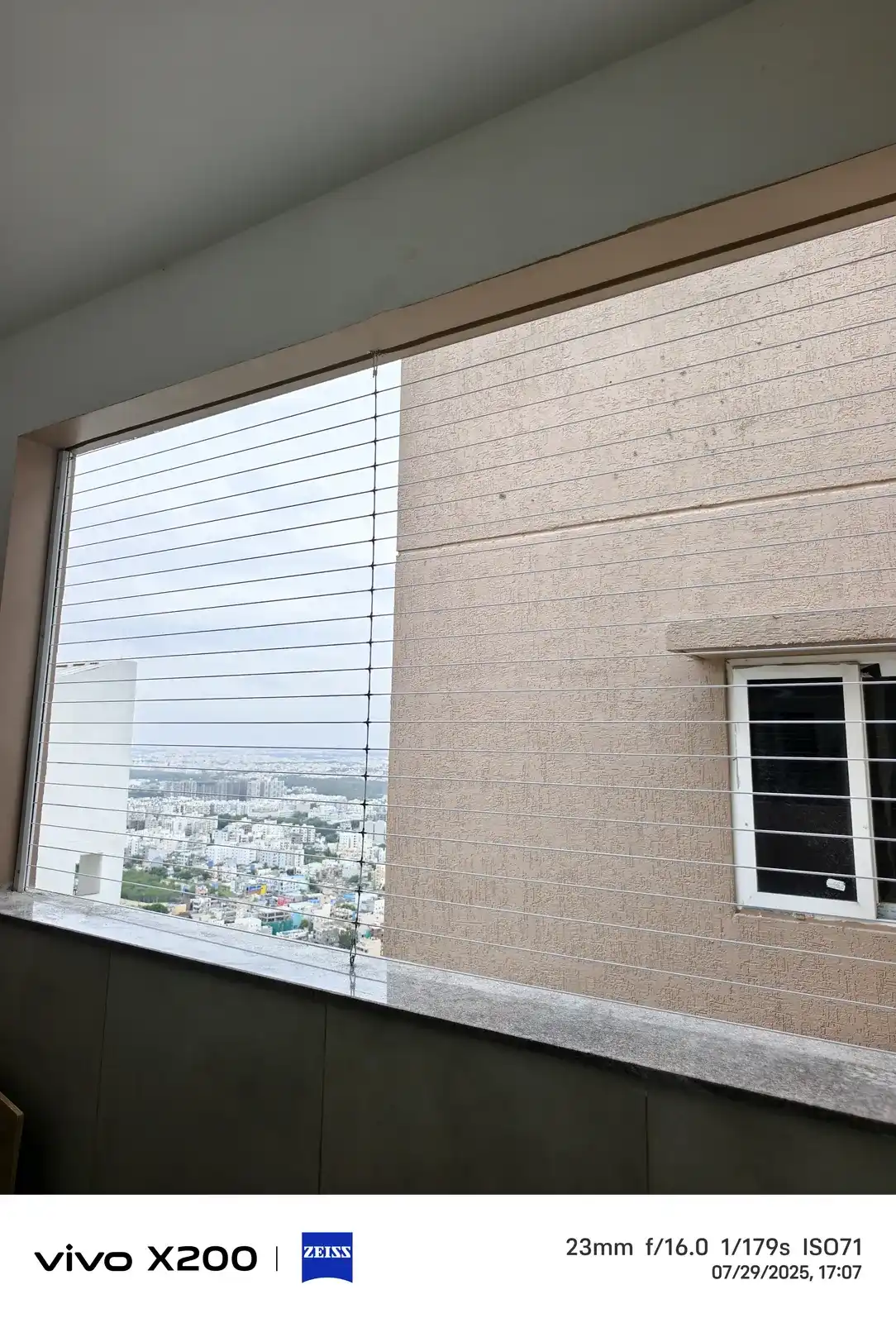
Life near the coast comes with sea breezes, and with a constant attack on anything made of metal. If you live in a city like Chennai or Visakhapatnam, or a town near the shore, you’ve probably seen rust stains under old window grills, hooks that crumble in your hand and hinges that seize up. Choosing the right materials from the start saves you from doing the job twice.
What makes the coast so hard on fittings
Salt. Sea spray carries fine salt particles inland on the wind. They settle on every surface, draw in moisture and greatly speed up corrosion.
Humidity. Damp air keeps surfaces wet for much longer, giving rust more time to work.
Sun. Strong sun and reflected light from water and sand break down plastics.
Wind and storms. Steady sea winds and cyclonic storms put a repeated load on nets and their anchors.
Sand. Blown sand wears at moving parts and collects in tracks and pulleys.
These forces work together. A small rust spot on a cheap hook weakens the fixing, the net loosens, the wind works on it, and failure follows.
Metal: the key choice
Almost every coastal failure starts with the metal, so this is where to spend your money.
| Material | Near the sea |
|---|---|
| Plain iron or mild steel | Rusts quickly; avoid |
| Galvanised steel | Lasts longer, but the coating wears |
| SS 202 stainless | Can rust in salty air; avoid |
| SS 304 stainless | Better, but it can show surface rust |
| SS 316 stainless | Best common choice for salty air |
| Aluminium | Good, with no red rust |
Stainless steel isn’t one material. All grades look alike when new, and the difference shows only after a few monsoons. SS 316 contains molybdenum, which helps it resist the chlorides in salt. Ask for it by name, and ask to see it stated in writing on the quotation.
Invisible grills
Near the sea, the grade of cable is the single most important decision. SS 316 is the right choice. Lower grades may look identical on the day they’re fitted, but they can show rust spots within a season or two. Aluminium tracks and stainless anchors complete the job. See invisible grills.
Steel grills, by contrast, are a constant battle on the coast. Paint fails first at the welds and at the point where bars enter the wall. Our comparison of invisible grills vs traditional grills goes into more detail.
Safety and pigeon nets
The net itself doesn’t rust, so salt isn’t the main concern. Strong coastal sun is, so make sure the net is UV-stabilised. HDPE is popular near the sea, because it absorbs almost no water. See HDPE vs nylon safety nets.
The weak point is the fixing. Use only:
- Stainless-steel hooks and eye bolts
- Stainless wire rope or coated wire for borders
- Stainless ties at the corners, not plain wire
Near the sea, anchors should also be closer together, because of the wind load. On a sea-facing balcony or a high floor, ask for a stronger border and more fixing points than you’d need inland. Our safety nets and pigeon nets pages have more on materials.
Cloth hangers
Plain steel rods will rust and mark your clothes. Choose stainless-steel rods with strong pulleys, and check the brackets as well, because they often use cheaper metal. Drying under cover is also more pleasant near the sea, as clothes on an open line can pick up salt and fine sand. See cloth hangers.
Sea-facing balconies
A balcony facing the water has the best view and the hardest time.
- Keep the view. Clear nets and thin vertical cables interrupt it the least.
- Expect wind. Close anchor spacing and firm tension matter most here.
- Expect salt. Rinse fittings often.
- Secure loose items. Pots and furniture can move in strong wind.
Looking after coastal fittings
Good materials need only a little care, but they do need some.
Rinse with fresh water. Salt that stays on metal keeps working. Use a damp cloth or a gentle hose, every few weeks on the beachfront and less often further inland.
Look after the cables. Wipe invisible grill cables and check for any brown marks, which are often only surface staining and can be cleaned off.
Check after storms. Look at corners, borders and anchors. A single loose tie is quick to fix before the next storm.
Clear the sand. Clean grit out of tracks, hinges and pulleys.
Oil the moving parts. Use a little suitable oil on hinges and pulleys that start to stiffen.
Before the storm season
Before the rains and cyclone months, walk round your home with this checklist.
- Press nets and cables to test the tension.
- Look at each anchor for rust or movement.
- Re-tie any loose corners.
- Take in loose pots and furniture.
- Check that drains on the balcony and roof are clear.
When a cyclone warning is issued, follow official advice, stay indoors and never go out onto a balcony or a roof to fix anything.
What to ask an installer
Before you agree to any work, ask:
- What grade of stainless steel is the cable and the hardware?
- Will that grade be written on the quotation?
- How far apart will the anchors be on this exposed side?
- Is the net UV-stabilised?
- What do I need to do to look after it?
A good installer will answer these without hesitating. If the answer is just “it’s stainless”, ask which grade.
The bottom line
Near the sea, the cheapest fitting often costs the most in the end. Buy SS 316 for cables and stainless steel for all hardware, use a UV-stabilised net, fix it closely and rinse it now and then. Do that, and your nets and grills will stand up to the coast for years.