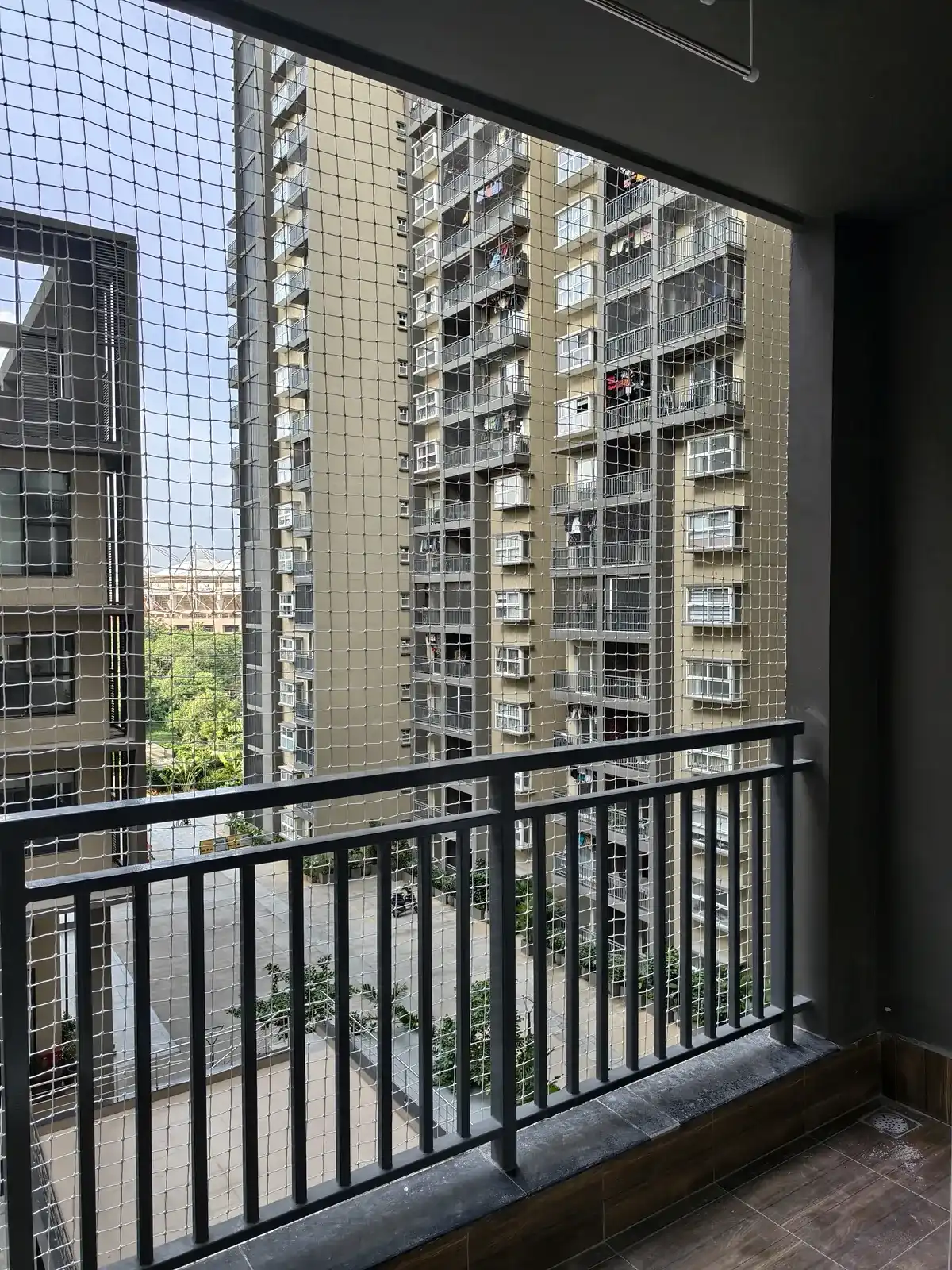
Once a net is up, it’s easy to forget about it. That’s partly the point: a good net sits quietly and does its job. But it spends every day in sun, dust, wind and rain. A simple routine keeps it clean, and more importantly, it lets you catch a problem while it’s still small.
Why looking after your net matters
Safety. A safety net that’s gone brittle can look fine but fail when it’s needed.
Effectiveness. One loose corner is all a pigeon needs.
Airflow. Heavy dust clogs a small mesh and slows the breeze.
Appearance. A clean net is almost invisible. A dusty one is very visible.
Life. Dust and grit rub against the twine, and droppings can damage it.
How to clean a balcony net
You’ll need a hose or a bucket of water, a soft brush or cloth, and perhaps a little mild soap. Choose a cool time of day.
- Stay inside the balcony. Never lean over the edge or stand on a chair or stool to reach the net.
- Dry-brush first. Use a soft brush to remove loose dust, leaves and feathers.
- Rinse gently. Spray with a hose on a soft setting, or wipe with a wet cloth.
- Treat marks. For droppings, use a little mild soapy water and a soft brush. Wear gloves and a mask for this job.
- Rinse again. Wash off any soap.
- Let it dry naturally. Sun and air will do it quickly.
Pay attention to the floor edge and corners, where dirt and feathers collect.
What not to do
- Don’t use bleach, acid, solvent or strong floor cleaners. They can weaken the fibres.
- Don’t use a pressure washer. It can damage the twine and strain the fixings.
- Don’t scrub with a wire brush.
- Don’t pull hard on the net to shake it clean.
- Don’t hang anything on it. Plants, wet towels and baskets strain the twine and the fixings.
- Don’t use it as a washing line.
How often to clean
| Where you live | Suggested rinse |
|---|---|
| Quiet residential street | Every month or two |
| Busy road or building site nearby | Every few weeks |
| Near the sea | Every few weeks, with fresh water |
| During the monsoon | Rain helps; check for leaves |
| Dry, dusty summer | More often |
Your monthly two-minute check
Once a month, walk along the net and do the following.
- Press it at a few points, especially at child height. It should give a little and spring back.
- Look at the corners. They take the most strain.
- Check the border. It should be tight, with no slack.
- Check the hooks. Look for movement or rust.
- Look for holes or broken threads.
- Check for climbing aids. Make sure no chair, pot or box has moved next to the net.
- Look at the floor edge. There should be no gap.
Your yearly check
Once a year, ideally after the summer and before the heaviest rains, take a closer look.
- Bend a small piece of twine. It should feel flexible, not stiff or crackly.
- Rub it between your fingers. Fibres or powder coming away means that it’s breaking down.
- Look for faded colour, which can be a sign of sun damage.
- Look at the side that faces the sun, because it ages first.
- Check that every anchor is still firm in the wall.
- Check any zip or hook-off panel.
Signs that a net needs replacing
Replace the net, or have it checked, if you see any of these.
- Twine that’s stiff, brittle or chalky
- Threads that snap with little force
- Several holes, or a large one
- Colour that’s badly faded on the sunny side
- A net that stays stretched out of shape after you press it
- Rusty or loose fixings that can’t simply be tightened
Take particular care with a safety net that protects a child. If you aren’t sure, get it checked. A safety net is no place to take chances. For a pigeon net, a small hole can often be patched, but a safety net that’s weakened in one place may well be weak all over.
Looking after the fixings
The twine gets the attention, but hooks and anchors do the real work.
- If stainless hooks show brown marks, they may just be stained, so wipe them clean.
- If a plain iron hook has rusted, replace it with stainless steel.
- If an anchor moves in the wall, don’t ignore it. Have it fixed properly.
- If the border has gone slack, ask for it to be re-tensioned rather than tying knots in it.
After a storm
Strong wind and heavy rain are the biggest tests. When it’s safe, take a look at the corners and top line, clear any leaves or debris that have stuck to the net, and check for anything blown into it. If something’s come loose on an upper floor, ask for help rather than trying to reach it yourself.
If you live near the sea
Salt attacks metal fixings. Rinse with fresh water regularly, and take a look at the hooks more often. Our guide to nets and grills for coastal homes has more detail.
If birds keep getting in
If pigeons are getting past the net, there’s a gap somewhere. Check the top corners, around AC pipes and at any access panel. Sometimes birds are simply using the outside of the net as a perch, or they’ve found a nearby ledge. See how to keep pigeons away from a balcony.
When to call for help
Call a professional if the net has loosened, if an anchor has moved, if there’s damage you can’t reach safely or if the net is getting old and you’re unsure. Never lean out over the edge to fix a net. On upper floors, that’s work for trained people.
If yours needs attention, see our balcony safety nets, balcony pigeon nets and safety nets pages.