If pigeons have moved into your balcony, you’ve probably been told two things: fit spikes, or fit a net. Both are real solutions, and both get sold for jobs they can’t do. The right choice depends on one question: are the birds using a line, or a space?
The basic difference
Bird spikes are strips of stainless-steel or plastic rods fixed along a surface. They don’t hurt a bird in normal use. They simply remove the flat area it needs to land and settle. So spikes protect a line: the top of a wall, a window ledge, a sign, a parapet.
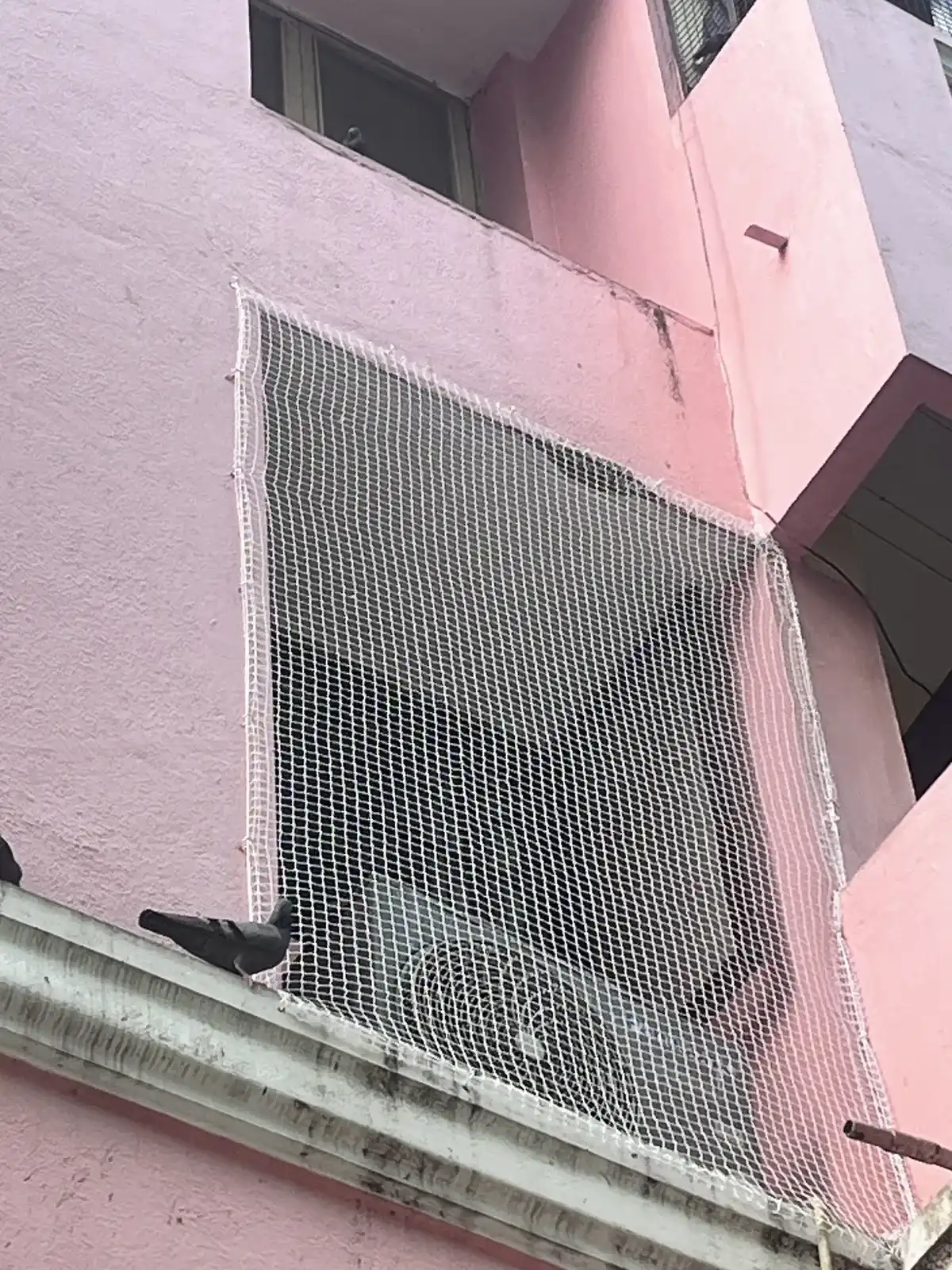
A pigeon net is a mesh stretched across an opening and fixed all the way round. It keeps birds out of everything behind it. So a net protects a space: a balcony, a light well, a duct, the gap behind an AC unit.
That single distinction answers most questions.
When spikes work
Spikes do well where birds can only sit on a narrow strip, and where there is nothing else nearby for them to use.
- Window ledges and sills that are narrow and exposed
- The top of a sign or beam on a shop front
- Parapet tops and boundary walls where birds line up
- Pipes and conduits that run along an outside wall
They’re also useful where a net would look wrong or can’t be fixed, such as the front of a heritage building or a very long exposed ledge.
When spikes fail
Spikes struggle whenever the bird has choices. Consider a typical balcony: a railing, a floor, an AC unit, a few pots, a shelf and the slab edge above. Fit spikes along the railing, and the pigeon lands on the AC unit instead. Fit them on the AC unit, and it goes to the floor behind the plants. You’d have to cover almost every surface, and the balcony would become unusable.
They also fail in these situations:
- When a nest already exists. Birds tied to a nest site are very determined. They’ve been known to build on top of spikes, using twigs to bury them.
- On wide ledges. A pigeon can often sit beside a strip that’s too narrow for the ledge.
- Where dirt collects. Droppings, leaves and twigs fill the spikes and gradually create a surface again.
When nets work
A net is the better choice almost any time birds are using an enclosed or semi-enclosed space:
- Balconies, because one net closes every perch at once
- Ducts and light wells, where birds nest out of reach
- AC ledges and brackets, where a small net encloses the space behind the unit
- Ventilators, which take a small framed net that still lets air through
- Gaps under roof sheets, closed by a strip along the wall
The key advantage is that a net doesn’t depend on guessing where a bird will land next. If the opening is closed, the bird can’t get in.
When nets fail
Nets fail through poor fitting far more often than through the material itself.
- A gap at the edge. Pigeons will find a small gap at the top or a corner. The net has to be fixed along every side.
- No tensioned border. A loosely hung net sags, flaps in the wind and lets birds push past.
- Plain iron hooks. These rust, stain the wall and let go. Stainless steel is the only sensible choice.
- The wrong net. Thin nets sold for garden use break down fast in strong sun. Look for UV-stabilised HDPE or nylon.
A net also isn’t ideal on a very long, open wall, where there’s no opening to close.
A side-by-side comparison
| Question | Bird spikes | Pigeon net |
|---|---|---|
| Protects | A line or ledge | A whole opening |
| Best for | Narrow, exposed perches | Balconies, ducts, AC ledges |
| Effect on view | None on the opening | Slight; clear nets are hard to see |
| Stops nesting in a space | No | Yes |
| Main weakness | Birds move to the next surface | Needs careful fitting |
| Upkeep | Clear debris from the strips | An occasional rinse |
What about other deterrents?
Plastic owls, reflective tape, wind spinners and ultrasonic devices are popular because they’re cheap and easy. They may work for a short time, but pigeons soon learn that an owl never moves and a spinner never attacks. Gels and sprays wear off, especially in the rain. None of them closes the space, and if birds are already nesting, none is likely to shift them. We go through the alternatives in our guide on how to keep pigeons away from a balcony.
How to decide
Stand where the birds gather and ask yourself these questions.
- Is there more than one place to land? If yes, you need a net.
- Is the area enclosed on two or more sides? If yes, a net is almost certainly better.
- Is there a nest? If yes, wait for any chicks to leave, clear it, then net the space.
- Is it a single, narrow, exposed strip? Spikes may be enough.
- Do you need to keep using the space? A net leaves a balcony fully usable; a floor of spikes doesn’t.
A common mixed solution
Many homes end up using both. A net closes the balcony, the duct and the area behind the AC unit, while a short run of spikes protects a narrow outside ledge that the net can’t reach. That’s usually cheaper than trying to do everything with one product.
After the birds have gone
Whichever you choose, clean up properly. The smell of old droppings keeps attracting other birds. Wear gloves and a mask, dampen dry droppings before removing them so that dust doesn’t rise, and wash the area. It’s worth doing this just before or just after the net goes up, so the site no longer smells like a home to them.
Who should fit it?
A short strip of spikes on a low ledge is an easy job for anyone comfortable with a tube of outdoor adhesive. Nets are different. They need strong fixing points, proper tension and, on upper floors, safe access. If the work means leaning out of a balcony or a window, leave it to a team with the right equipment. No amount of pigeon trouble is worth a fall.
If you’d like to see what a proper job involves, read about our pigeon nets and balcony pigeon nets. For shafts between flats, see duct area safety nets.